
Meet Amy: Turning Data into Clinical Insight at Qureight
As part of our “Meet the Builders” series we spoke to Amy Craster, one of our Senior Data Scientists, to talk about the challenge of turning data into insights that clinicians, sponsors and regulators can trust – insights that can ultimately influence how diseases are understood and how treatments are developed.
What originally drew you to data science?
I was always interested in the theory behind statistical models and machine learning.
What drew me more specifically to data science was the opportunity to apply those ideas to real-world problems. It’s one thing to understand how models work in theory, but using data to answer meaningful questions, particularly in healthcare, makes the work much more rewarding.
What motivated you to join Qureight?
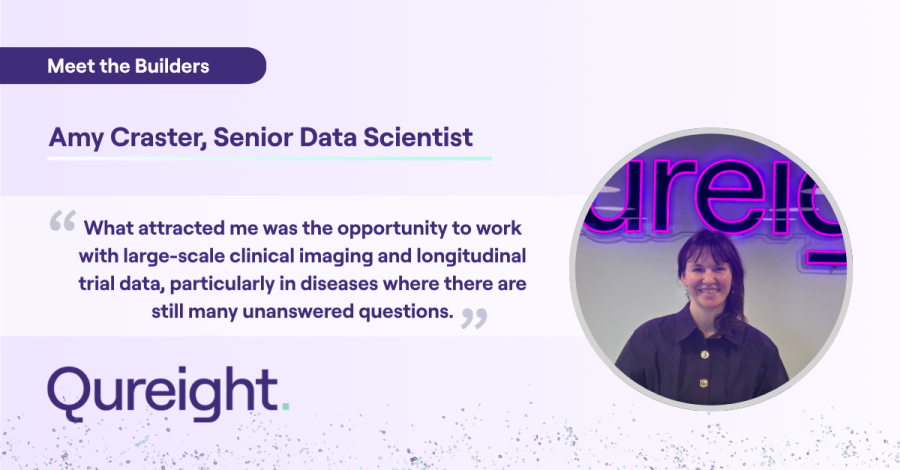
What attracted me was the opportunity to work with large-scale clinical imaging and longitudinal trial data, particularly in diseases where there are still many unanswered questions. It’s an environment where the analysis can directly contribute to research and clinical development decisions, which makes it feel more impactful.
What kinds of analytical problems are you solving day to day?
My role mainly involves analysing longitudinal clinical trial data alongside imaging-derived biomarkers to better understand disease progression and treatment response. That can include building statistical models, exploring relationships between imaging data and lung function, or evaluating how well certain measures predict clinical outcomes. Many projects also include integrating different types of data and translating those analyses into clear conclusions for clinical teams and sponsors.
What makes working with clinical imaging and longitudinal data different from typical datasets?
Clinical datasets are rarely straightforward. Patients are followed over long periods of time, measurements don’t always happen at consistent intervals, and different patients can show very different patterns of disease progression. Imaging data adds another layer of complexity because each scan contains a large amount of detailed information.
Working with this kind of data requires careful modelling, a strong understanding of study design, and a constant awareness of what the data can — and cannot — support.
What separates someone who can analyse data from someone who can generate clinical-grade insight?
Analysing data is about applying tools and producing outputs. Generating clinical-grade insight requires context and judgement. You need to understand the clinical question, the study design, the limitations of the data and the assumptions behind the models you’re using. The goal isn’t just to produce results, but to generate findings that clinicians, sponsors and regulators can trust and act on.
How do you ensure your outputs are robust enough for regulatory and sponsor scrutiny?
Careful statistical practice and transparency are essential. That means checking assumptions, testing how sensitive results are to different analytical choices, and being clear about the limitations of the data. Reproducibility is also key. Analyses need to be well documented so that others can review them and trust the results.
What assumptions do you find yourself challenging most often?
One common assumption is that a statistically significant result automatically means something clinically meaningful. Another is that more complex models will always produce better insights. In practice, that’s not always the case. Often, simpler models that are interpretable and robust are more valuable, particularly when working with real-world clinical data.
What excites you about the scale and type of data Qureight will handle in the coming years?
As datasets become larger and include more repeated measurements over time, there’s a real opportunity to better understand how diseases progress and how patients respond to treatment. Combining imaging biomarkers with clinical outcomes at scale could reveal patterns that are difficult to detect in smaller studies.
Being able to work with that kind of data opens the door to much deeper insight into disease biology and trial design.
What advice would you give someone considering joining the data science team?
Be curious about the clinical context. The most valuable work often comes from understanding the underlying disease, the study design, and the real question that clinicians or sponsors are trying to answer.
You will thrive at Qureight if you enjoy working on complex problems and want your work to have a tangible impact. It’s definitely an environment that suits people who like combining statistics, programming and domain knowledge. You also learn how to work with messy clinical datasets, collaborate closely with clinicians and researchers, and produce analyses that stand up to scientific and regulatory scrutiny.