
Meet Miguel: Principal Machine Learning Scientist at Qureight
As part of our “Meet the Builders” series, we spoke with Miguel Monteiro about his path into machine learning, the challenges of training models on clinical imaging data, and what excites him about the future of Qureight.
What did you do before joining Qureight?
Before joining Qureight I completed my PhD at Imperial College London, where I focused on machine learning for medical imaging. My research covered several areas, including segmentation of traumatic brain lesions on head CT scans, modelling uncertainty in segmentation tasks, and working on image counterfactuals.
My goal was to better understand how machine learning models can interpret medical images and how we can quantify the reliability of their predictions. Medical imaging presents some unique challenges, so a lot of the work involved designing methods that could operate effectively in that environment.
What attracted you to machine learning?
I became fascinated by the idea that you could teach a computer how to perform a task using example data, rather than explicitly programming it. That concept was very powerful to me. Instead of writing instructions for every scenario, you could train systems to learn patterns directly from data.
Once you start working in the field, you realise how many interesting problems there are to solve, particularly when applying machine learning to complex domains like medical imaging.
What separates good practitioners in your field from great ones?
I think the key difference is humility and curiosity. Machine learning evolves quickly. Methods that were state of the art a few years ago may already be outdated. Great practitioners recognise that and continue learning and improving rather than becoming fixed in one way of doing things.
What motivated you to join Qureight?
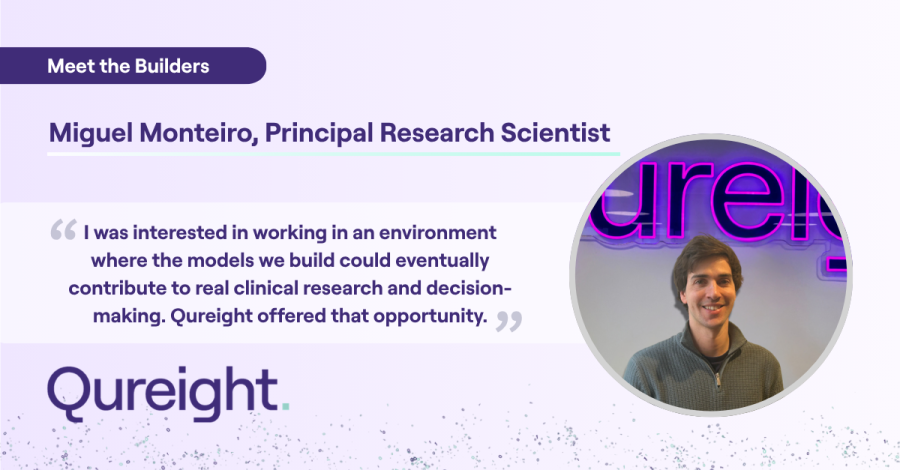
After finishing my PhD, I wanted to apply the skills I had developed in the real world. Academic research is valuable, but I was interested in working in an environment where the models we build could eventually contribute to real clinical research and decision-making. Qureight offered that opportunity, combining machine learning research with real-world clinical datasets and applications.
What do you do at Qureight?
My work focuses on developing computer vision models for 3D CT scans of the chest. That includes a range of approaches, from traditional segmentation and classification models through to generative models and self-supervised learning strategies.
One aspect I enjoy is that our team works across the full machine learning stack. We’re involved in everything from research and development of new models to building efficient parallel training pipelines and ultimately deploying and serving those models in production environments.
What are some of the hardest problems you’re solving?
One area we’ve been focusing on recently is building large 3D foundation models for chest CT scans. In many machine learning domains, if you want to improve performance you can simply gather more labelled data. In medical imaging, that’s often not possible because annotated data is scarce and expensive to produce.
Foundation models trained on large volumes of unlabelled imaging data can help address this problem. They allow us to learn useful representations of the data that can then be adapted to specific tasks.
What makes machine learning for clinical imaging different from typical machine learning problems?
The 3D nature of the data is a big factor. Most computer vision research focuses on two-dimensional images. In medical imaging, we’re often working with three-dimensional volumes, which increases both the computational complexity and the design challenges.
Another key difference is the scarcity of annotated data. In many domains, you can scale datasets relatively easily. In medical imaging, expert annotation is required, which makes the process far more limited. That forces us to think carefully about how we design models and training strategies.
Have you had to build anything internally because existing tools weren’t sufficient?
Yes, quite recently we had to build a data loader and transform pipeline from scratch. The standard PyTorch and MONAI tooling was simply too slow and resource-intensive for our use case. Since we’re working with large 3D imaging datasets, efficiency becomes very important. Building our own pipeline allowed us to optimise performance and make better use of available compute resources.
What do you find yourself debating most with your team?
One topic that comes up surprisingly often is Python typing and how best to structure training loops. These discussions might sound quite technical, but they’re important. Clear abstractions and well-designed code structures make it much easier to maintain and scale complex machine learning systems.
What excites you about the next few years at Qureight?
I’m excited about the opportunity to build one of the best machine learning teams in the world for medical imaging. There’s a lot of interesting work ahead, both in terms of developing new models and improving the infrastructure needed to train them effectively.
What advice would you give someone thinking about joining Qureight’s ML team?
The most important thing is to keep learning and improving. Machine learning changes quickly, so staying curious and continuing to develop your skills is essential. Much of the work involves exploring new approaches and solving challenges where there isn’t always a clear answer in advance. For someone who enjoys that kind of problem-solving, it can be a very rewarding place to work.